Parents naturally do everything they can for their child's health, yet eye examinations are often overshadowed by compulsory vaccinations and regular check-ups with the family doctor. And yet sight is one of the most important senses. A young child experiences much of the world around them through their eyes, and this sense lays the foundations for learning, movement coordination and social relationships. That is why paediatric ophthalmology is not just for children who wear glasses. It covers much more, and timing is the key to successful treatment. In Budapest, a growing number of specialist practices and private clinics offer paediatric eye care, with modern equipment and specialists who are patient and adaptable even with the youngest patients.
In this article, we explain in detail when and why to take your child to an eye specialist at each age, from birth through to school age. We also cover the symptoms and signs that should not wait until the next scheduled check-up and need immediate specialist attention. Finally, we describe what a first paediatric eye examination involves in practice, what the steps are, how to prepare, and how to make the experience as easy as possible for your child.
Why is an early paediatric eye examination so important?
The visual system does not finish developing at birth. The neural connections between the brain and the eyes form in the first 6–8 years of life and become established. If a vision problem is not treated during this period, it can irreversibly affect the development of the visual cortex. This condition is called amblyopia, commonly known as lazy eye. Lazy eye can be treated, but only while the visual system is still developing, that is, until around the age of 7–9.
To understand this, it helps to look briefly at what happens in a child's body during these early years. Sight is not a fully formed skill at birth. The eyes are there from birth, but the brain has to learn to interpret the visual information it receives. This learning process is extremely intensive in the first months of life and matures gradually until the age of 7–9. During this period, the brain gets used to the signals sent by the two eyes:
- it learns to combine the two images,
- perceive depth
- and distinguish fine details.
However, if one eye sends a blurred, misaligned or otherwise poorer-quality signal, sooner or later the brain starts to ignore it, and if this goes on for a long time, it becomes permanent. Once the developmental window closes, the visual cortex can no longer be reshaped as effectively, so early intervention is not just beneficial but in many cases the only way to preserve full vision.
Recommended examination schedule
Newborns and infants (0–12 months)
Minden Newborns are examined on the maternity ward for basic eye abnormalities. Doctors check the pupil reflex and the external appearance of the eyes and, if necessary, order a more detailed examination. If parents have any concerns, for example if
- the baby does not follow a light,
- one eye turns inwards or outwards,
- the eyelid droops,
- or the pupil looks white,
they should see an ophthalmologist straight away. A white pupil reflex (leukocoria), for example, may indicate retinoblastoma, a malignant tumour of the eye, which must be treated as quickly as possible. For premature babies, and for infants in whom the maternity ward examination found an abnormality, the ophthalmologist carries out the necessary checks in the first weeks of life.
Otherwise, the first scheduled eye screening is usually recommended at around 6 months of age. The examination at 6 months usually covers four main areas.
First, the external appearance of the eyes and the position of the eyelids are examined, checking for a drooping eyelid that could block the field of vision. Next, the pupil reflex is tested: a light is used to check whether both pupils react equally and adequately, which gives an idea of how mature the optic nerve and nervous system are. The third step is to examine the eye muscles and how the eyes move together, which can detect a squint at an early stage. Finally, the ophthalmologist performs the Brückner test, shining an ophthalmoscope light into both pupils at the same time. In a healthy eye, an even, reddish reflection should appear. Any asymmetry or whitish tint means further examination is needed. All of these tests are quick and painless.
Toddlers (1–3 years)
Parents should keep a constant eye on the eyes of a toddler who is learning to walk and developing rapidly. At this age, it is usually noticeable if something is wrong. If the child is always squinting, tilts their head to one side, avoids fine motor activities or shows no interest in looking at books, these are all signs that warrant a specialist examination. With a squint, that is, if one eye occasionally or constantly drifts away from the direction of gaze, you should also see an ophthalmologist without delay, because squint and lazy eye are closely linked.
From the age of 18 months to 2 years, once the child can cooperate, it is worth having the first more detailed eye screening. Modern ophthalmic equipment can detect simpler refractive errors even in infancy, but toddlers are better able to cooperate with the examination.
Pre-school age (3–6 years)
This stage is particularly critical. It is during this period that the last intensive phase of visual development takes place, and it is often at this time that it becomes clear whether a child is short-sighted, long-sighted or has astigmatism. If your child does not take part in a nursery screening, it is worth taking them to an ophthalmologist on your own initiative. In general, the first thorough, detailed eye examination is recommended at around 3–4 years of age, even if there are no symptoms.
Double vision (medically known as diplopia) means that the child sees two images of a single object at the same time, offset side by side or one above the other. It happens when the two eyes are not pointing at the same place and the brain cannot merge the information from the two different viewpoints into one coherent image. With healthy vision, the brain does this automatically and unnoticed. If the process breaks down, the double image immediately becomes a disturbing symptom.
At pre-school age, double vision is a particular warning sign if it appears suddenly, because the brain can partly adapt to visual problems that develop gradually, but not to a double image that appears suddenly. Younger children often cannot put this into words. Rather than saying "I see two", they tend to close one eye, tilt their head to one side, or avoid activities that strain their eyes. There can be many causes:
- squint,
- weakness or paralysis of the eye muscles,
- involvement of the nervous system,
- or, more rarely, raised pressure in the brain.
That is why double vision needs an immediate eye examination and, if necessary, a neurological assessment, which should not be put off for more than a few days.
School age (over 6 years)
Every child should have an eye examination before starting school. Starting school dramatically increases the strain on the eyes. Copying from the board, reading continuously and writing bent over an exercise book all require the kind of sustained visual concentration that an uncorrected vision problem immediately affects. It is not unusual for a vision problem to be noticed for the first time in the classroom. School screenings help, but they do not always detect every problem, so parents taking the initiative is also valuable. Children who already wear glasses should be checked by an ophthalmologist regularly, usually once a year.
Symptoms that need an immediate examination
Alongside regular screenings, there are symptoms that should not wait for the next scheduled examination. If any of the following signs appear, see a paediatric ophthalmologist urgently or, if necessary, an emergency eye service.
Squinting
Squint is one of the most common eye problems in children. One eye drifts inwards, outwards, upwards or downwards from the direction of gaze. It may be constant or only occasional, for example when the child is tired. It is important to know that in the first 3–4 months a baby's eyes may naturally move in a less coordinated way, but any squint after 4 months of age should be investigated. A squint is not just a cosmetic issue: if one eye regularly drifts, the brain gradually suppresses its image and a lazy eye can develop.
To understand this, consider what happens in the brain. With normal vision, both eyes point at the same spot, and the brain merges the slightly different images from the two eyes into a single three-dimensional view, which makes depth perception and 3D vision possible. But if one eye regularly drifts, the two eyes send different images to the brain. At first the brain tries to reconcile the two, which can cause double vision, but because this is disturbing, after a while the brain protects itself by simply switching off the signal from the squinting eye. This happens gradually and unnoticed, and the child usually does not complain, as their vision with one eye seems fine. Meanwhile, however, the area of the visual cortex linked to the squinting eye receives less and less stimulation, the visual system falls behind normal development, and a lazy eye develops.
Double vision
If a child sees double, that is, two images of the same object at once, it may indicate a serious eye or neurological problem. Younger children often cannot describe this, and instead squint with one eye or tilt their head to suppress one of the images. Double vision that comes on suddenly needs an immediate medical examination.
The The possibility of nervous system involvement deserves particular attention, because the movement of the eye muscles is controlled by nerve pathways from the brain. If these are damaged or put under pressure for any reason, it shows in how the eyes move together. With sudden double vision, the doctor needs to rule out causes such as
- raised pressure in the brain,
- the after-effects of a head injury,
- an inflammatory disease of the nervous system,
- or, more rarely, a brain tumour.
These conditions are relatively rare, but precisely because they are serious, they must not be overlooked. In such cases, the ophthalmologist examines not only the eye but also the pattern of eye muscle movement, the behaviour of the pupil reflex and any accompanying symptoms, such as headache, nausea, balance problems or facial asymmetry, to decide whether a neurological consultation or imaging is needed.
Astigmatism
In astigmatism, the cornea (the clear front surface of the eye) is not perfectly spherical but slightly elongated, shaped more like a rugby ball than a football. As a result, incoming light is not focused at a single point on the retina but on two different planes. The result is a blurred or distorted image both close up and at a distance.
Astigmatism does not necessarily cause obvious symptoms in early childhood, but it may be linked to an unusual head position, headaches, eyes that tire quickly, or the child leaning close to everything they look at. Astigmatism can usually be corrected well with glasses, but the earlier treatment starts, the better the results.
A white or unusually coloured reflection in the pupil
If photos show a white, yellow or other coloured reflection in your child's eye instead of red, it may indicate retinoblastoma, cataract or another abnormality. This needs an immediate eye examination without delay, ideally the same day.
External changes to the eye
Folyamatos
- Watering,
- discharge,
- redness,
- duzzanat,
- a constantly drooping eyelid,
- frequent blinking
- and eye rubbing
are all signs that warrant an eye examination. Some of these may of course have more everyday causes (such as allergy or conjunctivitis), but other causes can only be ruled out by an examination.
Headaches, learning difficulties, clumsiness
Many parents do not think of it, but recurring headaches, especially after reading or screen time, persistent inattention at school, mixing up letters and general clumsiness (bumping into walls, missing objects) can all be linked to a vision problem. If a child cannot see well, they are forced to compensate, which can lead to tiredness, irritability and poorer performance.
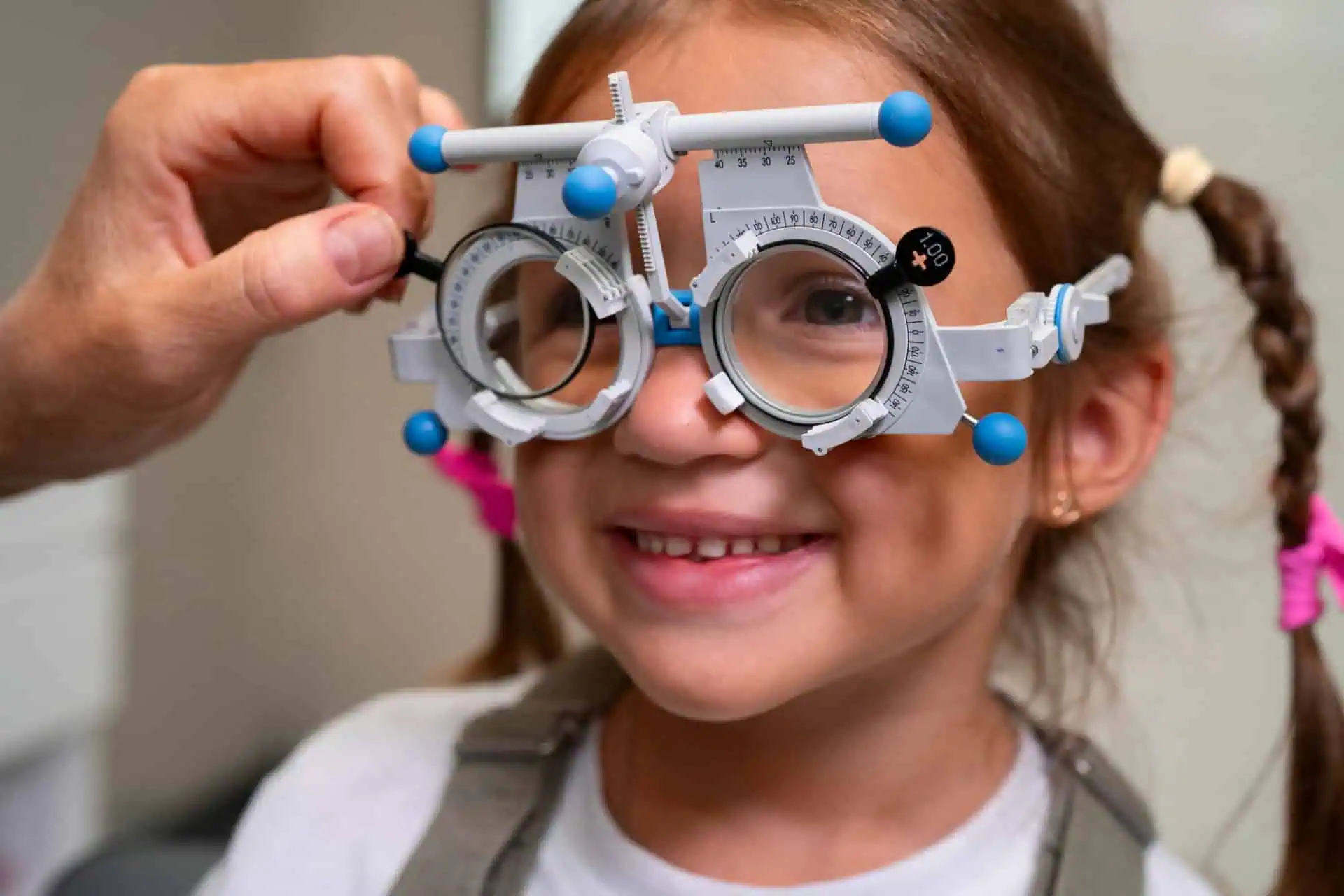
What happens at the first eye examination?
Many parents put off seeing a paediatric ophthalmologist because they do not know what to expect. In reality, the first examination is much less daunting than people imagine. A paediatric ophthalmologist is trained to work patiently and playfully even with the youngest patients.
Medical history and questions for parents
The examination usually starts with detailed questions. The doctor will ask what symptoms you have noticed, whether there are eye conditions in the family (such as squint, wearing glasses or lazy eye), how the pregnancy and birth went, whether the baby was premature, and which developmental milestones your child has reached. It is worth gathering this information in advance so that the examination can be as efficient and smooth as possible.
Measuring visual acuity
How visual acuity is measured depends on age. For younger children, picture or symbol charts are used (E charts, Lea symbols), which do not require knowing letters. Most pre-school children cooperate well with this test.
For babies, special behaviour-based methods are used. One of the most common is preferential looking, based on the principle that a baby with healthy vision instinctively prefers a patterned, striped surface to a plain one. During the test, striped patterns of varying fineness are held in front of the baby. The finer the stripes they can distinguish from the plain background, the better their visual acuity. If the baby shows no preference, that is, does not turn towards the patterned stimulus, it may indicate poorer visual acuity.
Another commonly used method is measuring visual evoked potentials, in which electrodes placed on the child's head measure the brain's response directly while the baby looks at changing patterns. This method is particularly reliable and requires no active cooperation. These tests are completely painless and seem to the baby more like an interesting game than a medical procedure.
Examining the eye muscles
The doctor checks whether the two eyes move together and whether there is a squint. Several methods are used:
- Hirschberg test (light reflex test):
The examiner holds a small light in front of the child's eyes and observes where the reflection appears on the pupils. In healthy, straight eyes, the reflection appears symmetrically at the same point on both pupils; if it is displaced on one side, this indicates a squint. - Cover test:
One eye is covered with a paddle while the child looks at an object or light, and the reaction of the uncovered eye is observed. If the uncovered eye has to adjust its gaze, that is, moves to look at the target, this shows that it was not looking in the right direction before, meaning there may be a squint. - Testing active eye muscle movement:
The examiner moves a light or an interesting object in different directions across the child's field of vision, watching whether both eyes follow the movement smoothly and freely. If one eye gets stuck, lags behind or drifts in a particular direction, it may indicate weakness or paralysis of the eye muscle that controls that direction.
Determining refractive error
To determine a refractive error (short-sightedness, long-sightedness, astigmatism) accurately, the pupils almost always need to be dilated. This is done with eye drops. The drops dilate the pupil and relax the focusing muscle, so the doctor can measure the true refraction without the child's own focusing effort distorting the result.
A szemcseppek effect lasts a few hours, during which the child may be more sensitive to light and see close objects blurrily; this is completely normal and temporary. It is worth bringing sunglasses for this time, and bear in mind that on the day of the examination it is best not to give your child screens or books.
Examining the back of the eye
Through the dilated pupil, the doctor examines the internal structures of the eye:
- the retina,
- the optic nerve,
- az ereket.
This fundus examination provides important information about the overall health of the eye and makes it possible to rule out certain rare but serious conditions.
What to bring and how to prepare your child
For the first eye examination, it is worth bringing
- previous medical records,
- your child's health record book,
- and any previous eye examination results.
If your child already wears glasses, bring them too. An unfamiliar medical environment can be stressful for young children, so it is worth explaining what will happenin advance, in a calm voice. Emphasise that it will not hurt and that the doctor wants to help their eyes. Bring a favourite toy or book for the wait.
Paediatric ophthalmology in Budapest
In Budapest's public healthcare system, specialist paediatric eye care is available with a referral. The family doctor or paediatrician issues the referral, after which examinations are available at specialist outpatient clinics designated by the National Hospital Directorate-General or in the eye departments of larger hospitals. Waiting times vary by district and institution.
At private clinics and specialist practices, examinations are available without a referral and usually with shorter waiting times. Many private clinics in Budapest have a paediatric ophthalmologist who specialises in young children, with consulting rooms designed around their needs.
In urgent cases, do not wait for a scheduled appointment. Your child can receive immediate care at the emergency eye service of larger hospitals.
Paediatric ophthalmology at Saint James Clinic
If you are looking for a reliable place in Budapest for your child's eye examination, at Saint James Eye Clinic we provide comprehensive paediatric eye care with modern equipment and experienced specialists.
The examination gives a comprehensive picture of the condition of your child's eyes. Everything can be done in one place, from measuring visual acuity, checking eye alignment and screening for squint, to examining the cornea, the back of the eye, tear production and the tear ducts. The examination can therefore also identify hidden problems that, without treatment, would affect your child's development, learning and everyday life in the long term.
At the clinic, we take particular care to ensure that the examination is a calm, safe experience for your child too. A play corner awaits little ones while the dilating drops take effect, parents can stay for the whole examination, and we explain every step clearly to both child and parent. At the end of the examination, parents receive detailed information and written recommendations on next steps.
What can parents do for their child's sight?
Besides visits to the ophthalmologist, parents can do a lot at home for their child's eye health. One of the most important factors is limiting screen use. The World Health Organization (WHO) recommends no screen time for children under 2, no more than one hour a day between the ages of 2 and 5, and moderate use with regular breaks over the age of 6.
Natural light is also good for the eyes. Research shows that spending at least 1–2 hours outdoors a day reduces the risk of developing short-sightedness. This is especially important at school age.
If your child is prescribed glasses, make sure they actually wear them. Have the glasses checked regularly, and if your child complains or the lenses get scratched, sort the problem out as soon as possible.
Final thoughts
Paediatric ophthalmology is not just for children with vision problems. Every child needs regular eye checks, because the developmental window of the visual system is narrow and problems become harder to correct over time. Examinations should take place regularly. In urgent cases, such as squint, double vision, a white pupil reflex or sudden loss of vision, see a specialist as soon as possible.
In Budapest, specialist paediatric eye care is available in both the public and private systems. A child's vision can affect their whole future: learning, sport and social life all depend on good sight. So it is worth taking this seriously and not putting off eye examinations.
If you want the best possible care for your child, choose Paediatric Ophthalmology at Saint James Clinic. Do you have further questions or would you like to book an appointment? Get in touch; our team will be happy to help.